
News
04.05.2026
Q1 2026 Rental Market Update
A more considered market, and a greater need for strategy
Throughout the first quarter of 2026, rental demand across Newcastle, Lake Macquarie and the Hunter has remained steady. Enquiry levels are still strong and there is no shortage of tenants looking for well-located, quality homes.
What has changed is how tenants are making decisions. We are seeing a shift toward a more considered market, where strong demand does not automatically translate into stronger rental growth. Instead, results are increasingly shaped by how a property is presented, priced and managed from the outset.
Watch: Q1 Rental Market Update with Catherine Russell
If you want a clearer understanding of how the rental market is performing on the ground and what it means for your investment, Catherine Russell shares what we are seeing across the region below.
Not all properties are performing the same in this market, and the reasons why are becoming more obvious.
Demand is steady, but tenants are more selective
Tenant enquiry has held across the region, however the way tenants are engaging with the market has shifted.
Rather than applying quickly, tenants are taking the time to compare options. Location, presentation and overall quality are playing a much bigger role in decision making. Features such as air conditioning, solar and the level of finish throughout a property are now being weighed up more carefully.
This has created a more competitive environment, even in areas where demand remains strong.
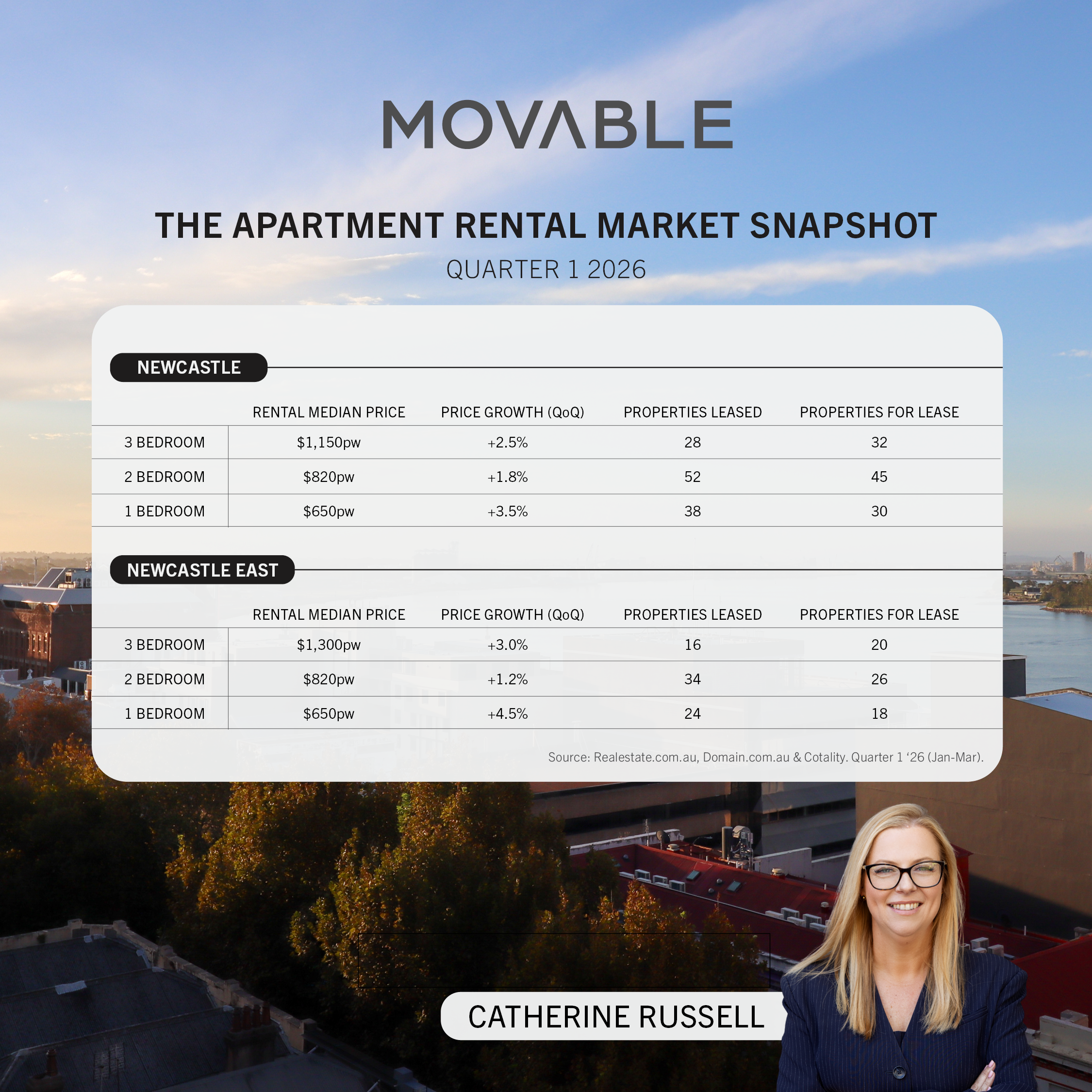
Rental growth reflects this shift. Across the first quarter, increases have generally sat in the range of 1 to 3 percent, with well-positioned properties achieving the best outcomes.
Q1 Snapshot: Newcastle & Newcastle East Apartment Market
Pricing and presentation are setting the benchmark
One of the clearest trends emerging this quarter is the widening gap between top-performing and underperforming properties.
Properties that are priced correctly from day one and presented to a high standard are continuing to attract strong enquiry and quality applications. These are the properties that lease efficiently and achieve consistent results. By contrast, properties that are overpriced or lack presentation are taking longer to lease and often underperform against expectations.
In today’s market, simply listing a property is no longer enough. The way it is positioned from the outset has a direct impact on the result.
Increased choice is shaping tenant behaviour
This is particularly evident in the inner-city apartment market, from Wickham through to Newcastle East.
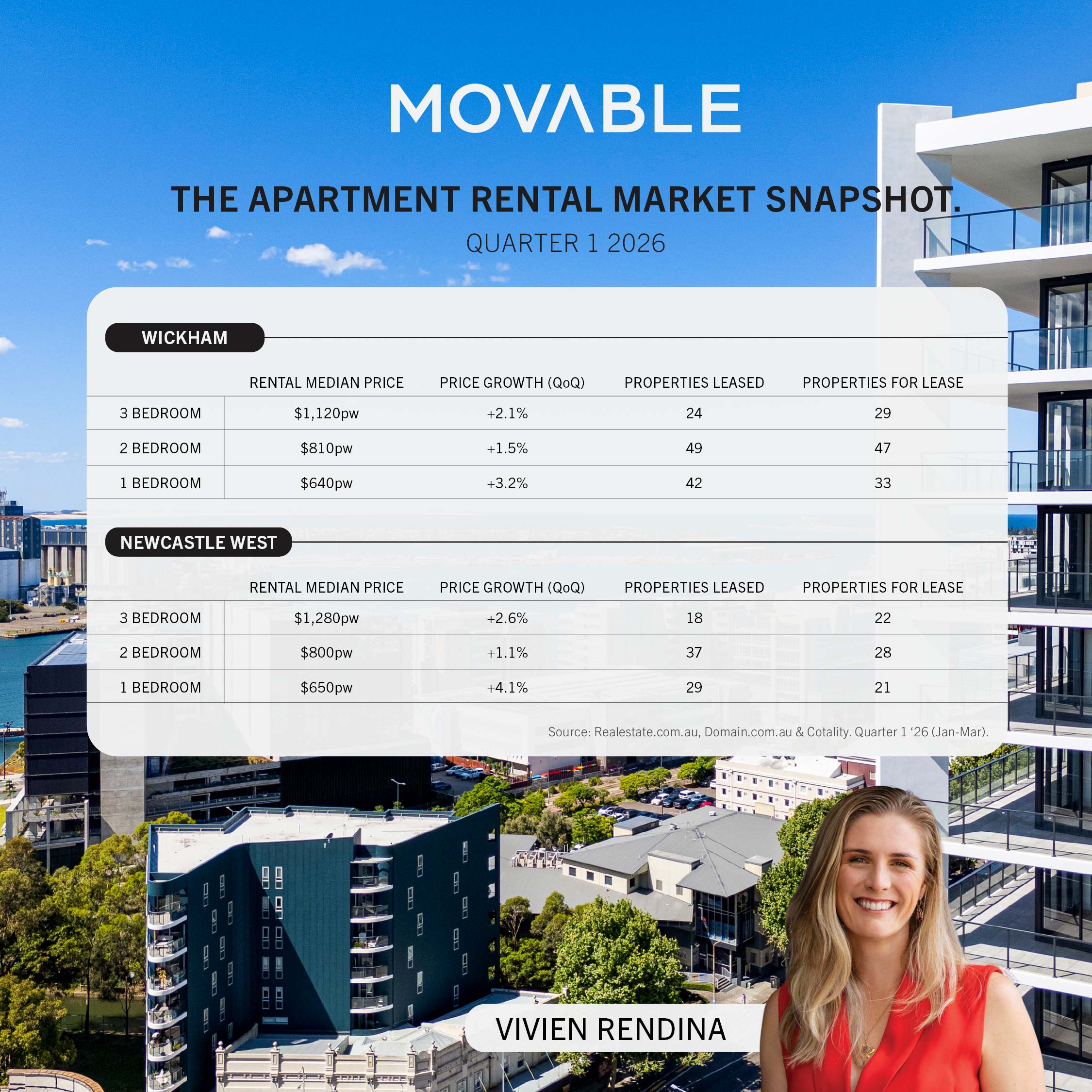
Q1 Snapshot: Wickham & Newcastle West Apartment Market
With a mix of new developments and established apartments available in similar locations, tenants now have more choice and more time to consider their options. Proximity to the harbour, light rail and lifestyle amenities remains highly desirable, but it is no longer the only factor driving decisions.
Current leasing ranges reflect this balance between demand and competition. One-bedroom apartments are generally achieving between $640 and $700 per week when well presented. Two-bedroom apartments are sitting around $800 to $850 on average, with newer stock pushing higher. Larger, premium apartments continue to perform well at the top end, particularly those offering space and lifestyle appeal.
Even in high-demand pockets, results are closely tied to how a property is priced and presented.
A more proactive approach is now required
Another shift this quarter has been the impact of longer notice periods and more structured tenancy processes.
With tenants often having greater visibility of upcoming availability, they are able to plan ahead and assess multiple options. For landlords, this means longer lead times and a need for more deliberate campaign planning.
Property management has moved further away from a reactive model. It now requires a more proactive, strategic approach that considers timing, marketing and tenant engagement well before a property goes live.
The difference is in the strategy
Perhaps the most important takeaway from the first quarter is that not all rental properties are performing equally, even within the same suburb or building.
The difference is rarely the property itself. It is the strategy behind it.
Top-performing properties are actively managed throughout the leasing process. Feedback from open homes is considered, application quality is assessed carefully, and communication between landlord and property manager is ongoing.
Underperforming properties are often the result of a more passive approach, where pricing, presentation and tenant targeting are not adjusted in line with market feedback.
In a more considered market, that gap becomes more pronounced.
Planning for the rest of 2026
For landlords, the focus now needs to shift toward planning rather than reacting.
This starts with being clear on your goals. Whether you are holding long term or considering a sale in the next 12 to 18 months, your leasing strategy should align with that outcome. Pricing, presentation and tenant selection all play a role in supporting that strategy.
Small improvements can have a meaningful impact. Updates to presentation, improvements in marketing and a clear understanding of where your property sits in the current market can influence both the quality of tenants and the overall return.
More importantly, having a defined strategy in place helps reduce vacancy and ensures your investment is working as effectively as possible.
Make the Move
As we move further into 2026, the market is expected to remain stable, but increasingly selective.
For landlords, this creates both opportunity and risk. Well-positioned properties will continue to perform, while those without a clear strategy may fall behind.
If you are unsure how your property is currently positioned, or whether your approach is delivering the best possible outcome, it may be time to take a closer look.
👉 Make the move: https://www.movable.com.au/make-the-move/